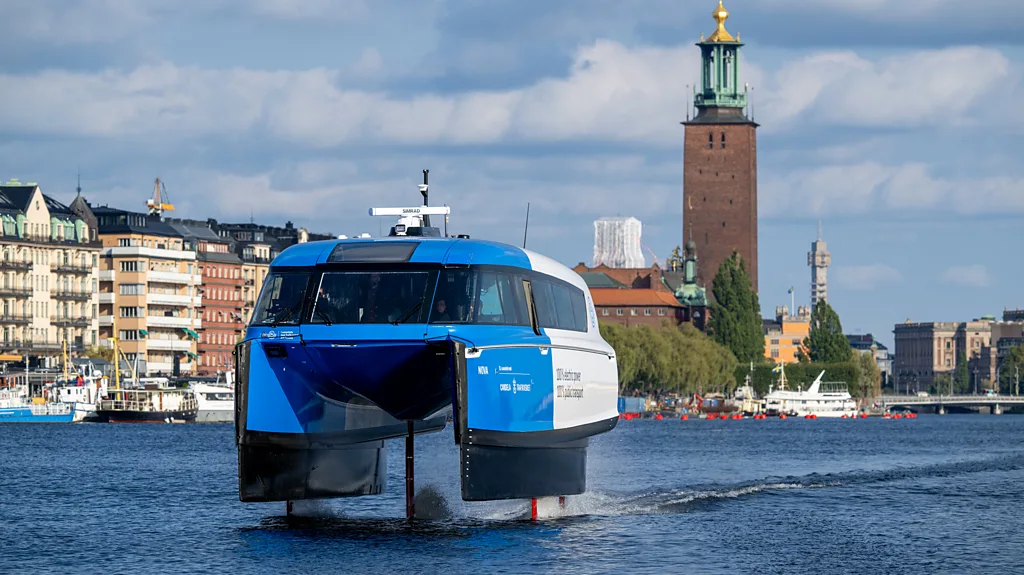
Born from a desire to make boats go faster, today the hydrofoil is being revived as a cleaner form of water transport by helping boats rise above the waves.
It would have made an unusual sight in 1860s France – a rowing boat rising and appearing to float high on the water, a series of wedges helping to raise its hull upwards as its occupant pulled hard on the oars. It’s not known if this hydrofoil boat was ever built by Parisian inventor Emmanuel Denis Farcot, who filed the first patent for a vessel of this kind in 1869. What is clear, however, is that over the next 50 years others would succeed in “flying” a boat above the water.
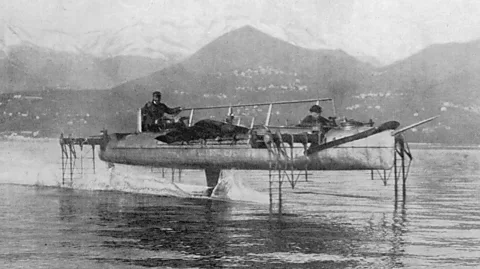
Italian inventor Enrico Forlanini floated a working hydrofoil boat on Lake Maggiore in the Italian Alps in 1906. Canadian Alexander Graham Bell, who invented the telephone, also developed several hydrofoil technologies in his quest to design an early aeroplane. Bell’s fourth hydrofoil vessel, known as HD-4, was clocked travelling at more than 70 mph (113 km/h), which broke a world speed record for watercraft and held onto the title for a decade.
“In the early 1900s, people were experimenting with hydrofoils and they gave the craft some interesting characteristics, like higher speed, low drag – seakeeping characteristics that are different from other types of boats,” says Jakob Kuttenkeuler, professor of naval architecture at Sweden’s KTH Royal Institute of Technology.